Benchmarks
We benchmarked LinkML-Scala against the reference linkml Python package by measuring the throughput (generations per second) of the SHACL and JSON Schema generators.
Methodology
Section titled “Methodology”The benchmarks emulate two different usage patterns:
- Cold start – end-to-end generation invoked from the CLI. This emulates a workflow typical for CI scripts and interactive schema authoring, where the process starts, generates once, and exits.
- Warm – the generator runs repeatedly in a loop inside an interpreter/JIT. This emulates a persistent server application.
- Implementations: LinkML-Scala 0.9.3 and LinkML (Python) 1.11.1.
- Runtimes: OpenJDK 25.0.2+10-LTS and CPython 3.14.6 (unless otherwise stated).
- Test bench: Intel Core Ultra 9 285K (3.7 GHz, boost 5.7 GHz), 64 GB DDR5-6400, Ubuntu Desktop 24.04 (Linux 6.14).
- Cold-start harness: the hyperfine CLI tool, driving the LinkML-Scala native binary (Oracle GraalVM Native Image 25.0.1+8.1) and the default LinkML (Python) CLI script.
- Warm harness: the Java Microbenchmark Harness (JMH) for LinkML-Scala and a plain Python script for LinkML (Python). Both implementations parse schemas and resolve imports in a set-up phase, so all models are in memory before measurement. Each scenario ran 5 warm-up + 10 measurement runs across 5 forks.
Datasets
Section titled “Datasets”We collected 11 diverse LinkML schemas by browsing the LinkML Schema Registry and public GitHub repositories. They span domains such as cybersecurity (d3fend, iso27001), finance (cdm), biology (nmdc, crdch, include), and energy (tc57cim). Several schemas required minor manual repairs (missing prefixes, invalid URIs). The full dataset is
published at NeverBlink-labs/linkml-benchmark-schemas.
Classes and Attributes are the materialized (induced) totals.
| Schema | Files | Size (KiB) | Classes | Attributes |
|---|---|---|---|---|
| bridge2ai | 1 | 39.5 | 38 | 160 |
| cdm | 37 | 2237.9 | 779 | 3245 |
| chem-dcat | 5 | 117.4 | 89 | 889 |
| crdch | 1 | 1064.8 | 41 | 335 |
| d3fend | 1 | 2591.3 | 4366 | 5250 |
| fluxnova | 17 | 244.3 | 258 | 2765 |
| include | 1 | 56.3 | 10 | 149 |
| iso27001 | 1 | 251.7 | 35 | 781 |
| nmdc | 14 | 558.8 | 80 | 1655 |
| sssom | 1 | 59.4 | 9 | 110 |
| tc57cim | 1 | 2952.3 | 1528 | 34172 |
Results
Section titled “Results”Cold start
Section titled “Cold start”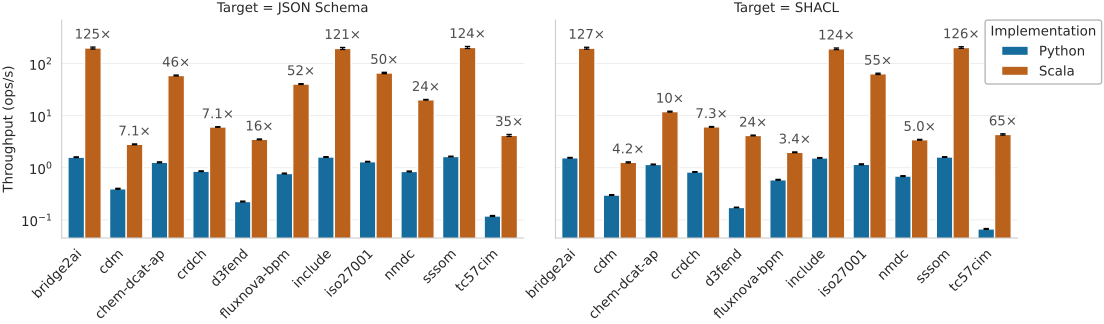
Summary
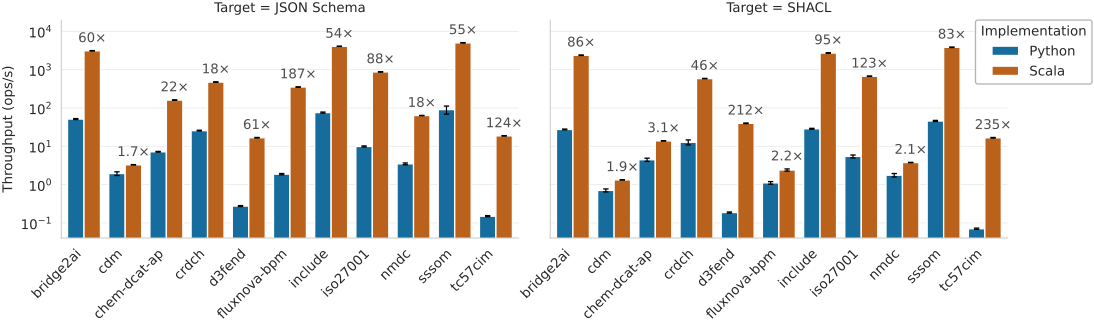
Section titled “Summary”We define speedup as the ratio of LinkML-Scala’s throughput to LinkML (Python)’s throughput. The geometric mean speedup was:
| Scenario | JSON Schema | SHACL |
|---|---|---|
| Cold start | 36.5× | 22.9× |
| Warm | 38.5× | 26.8× |
LinkML-Scala was faster than LinkML (Python) in every tested scenario.
Discussion and limitations
Section titled “Discussion and limitations”The speedup is far from uniform across datasets – in the warm JSON Schema benchmark it ranges from 1.7× to 187× (two orders of magnitude). These differences may stem from uneven feature coverage between the implementations, unoptimized code paths in LinkML-Scala, or very text-heavy (hard-to-optimize) schemas. We plan to investigate these outliers in follow-up work.
For small datasets in the cold-start scenario, LinkML-Scala is mainly limited by the startup time of its GraalVM-compiled binary (~2.5 ms on a modern Linux machine). Some schemas (e.g., sssom) were generated in only ~5 ms, making startup roughly half of the elapsed time.
- Benchmark code and datasets: NeverBlink-labs/linkml-benchmark-schemas
- Paper preprint: LinkML-Scala: a Robust, Fast, and Portable Implementation of LinkML